Customer Data Modeling
Customer profile and event schema engineering
Identity-aware models aligned to warehouse and activation
Governed data structures for scalable cross-channel personalization
Customer data modeling defines how identities, profiles, events, and attributes are represented across your CDP ecosystem. It establishes consistent entity definitions, relationships, and naming conventions so that analytics, segmentation, and activation teams work from the same customer semantics rather than tool-specific interpretations. This is the foundation for CDP data model architecture and durable Customer 360 schema design.
Organizations need this capability when data sources expand, tracking evolves, and multiple activation destinations depend on the same customer view. Without a clear model, identity resolution rules become brittle, event payloads drift, and teams duplicate logic in pipelines, dashboards, and audiences—slowing delivery and increasing operational risk.
A well-structured model supports scalable platform architecture by aligning CDP objects to warehouse structures, defining data contracts and schema versioning for producers and consumers, and enabling controlled evolution through governance. The result is a durable foundation for cross-channel customer profile modeling, reliable measurement, and operational workflows that can change without breaking downstream systems.
Core Focus
Customer 360 entity modeling
Event and attribute schemas
Identity graph design
Data contracts and versioning
Best Fit For
- Multi-source customer ecosystems
- CDP plus warehouse architectures
- Cross-channel activation programs
- Teams standardizing tracking
Key Outcomes
- Consistent customer definitions
- Lower schema drift risk
- Faster audience build cycles
- Reusable analytics semantics
Technology Ecosystem
- CDP data objects
- Data warehouse modeling
- Identity resolution rules
- Metadata and lineage tooling
Platform Integrations
- Ingestion pipelines
- Consent and preference stores
- Activation destinations
- Analytics instrumentation
Problems Customer Data Modeling Solves
As CDP programs mature, customer data quickly becomes fragmented across ingestion pipelines, identity graphs, event streams, and activation destinations. When teams lack a shared customer data model, each system tends to encode its own definitions for profiles, accounts, households, and identifiers. The result is inconsistent Customer 360 schema design across tools, making it difficult to reconcile reporting, segmentation, and operational workflows.
Tracking and instrumentation changes introduce additional instability. Without a clear event taxonomy and tracking plan, event names, properties, and payload shapes drift over time, and downstream consumers compensate with ad hoc transformations. This creates brittle dependencies in analytics engineering, increases maintenance overhead, and makes it hard to compare performance across channels or time periods. Identity resolution is similarly affected: when identifier semantics and merge rules are not modeled explicitly, identity resolution modeling becomes opaque, hard to test, and prone to regressions that silently change audience counts and attribution.
At enterprise scale, governance gaps amplify risk. Without data contracts and schema versioning, producers can ship breaking changes, and consumers cannot reliably validate or monitor schema compliance. Misalignment between CDP objects and warehouse-aligned dimensional modeling leads to duplicated logic, inconsistent metrics, and delivery bottlenecks as teams repeatedly re-map the same concepts for new use cases. Over time, these inconsistencies accumulate as technical debt, slowing activation and increasing the cost of change.
Business Impact
A consistent customer data model reduces ambiguity across teams and tools, improving the reliability of segmentation, measurement, and activation. Clear Customer 360 schema design and identity resolution data modeling help stabilize audience counts and attribution, while a defined event taxonomy lowers rework in analytics engineering. Data contracts and schema versioning reduce breaking changes and operational risk, supporting faster delivery and more predictable platform evolution.
These related services extend customer data modeling into adjacent CDP architecture work—integrating upstream sources, orchestrating journeys, and designing activation and personalization patterns that depend on consistent Customer 360 schemas, event definitions, and governed identity resolution.
CRM Data Integration
Enterprise CRM data synchronization and identity mapping
Customer Journey Orchestration
Event-driven journeys across channels and products
Data Activation Architecture
CDP audience activation with governed delivery to channels
Marketing Automation Integration
Audience sync activation engineering for CDP activation
Personalization Architecture
CDP real-time decisioning design for real-time experiences
Customer Analytics Platforms
Customer analytics platform implementation for governed metrics and behavioral analytics
Customer Intelligence Platforms
Unified customer profile architecture and insight-ready datasets
Customer Segmentation Architecture
Scalable enterprise audience segmentation models and cohort definition frameworks
Experimentation Data Architecture
Consistent experiment tracking, metrics, and attribution
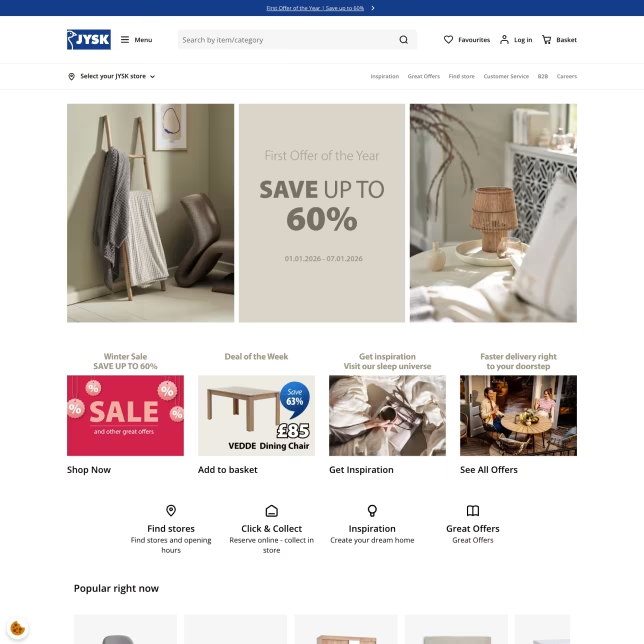
JYSK required a robust retail Digital Experience Platform (DXP) integrated with a Customer Data Platform (CDP) to enable data-driven design decisions, enhance user engagement, and streamline content updates across more than 25 local markets.
- Streamlined workflows for faster creative updates. - CDP integration for a retail platform to enable deeper customer insights. - Data-driven design optimizations to boost engagement and conversions. - Consistent UI across Drupal and React micro apps to support fast delivery at scale.
The modernized platform empowered JYSK’s marketing and content teams with real-time insights and modern workflows, leading to stronger engagement, higher conversions, and a scalable global platform.
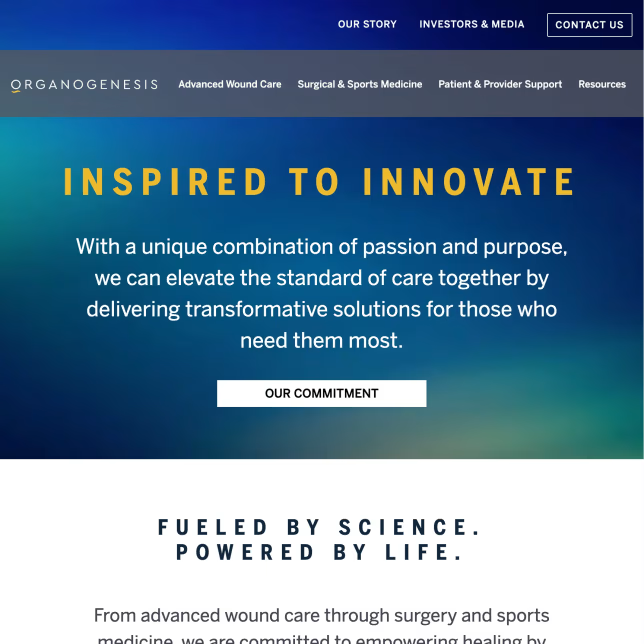
Organogenesis faced operational challenges managing multiple brand websites on outdated platforms, resulting in fragmented workflows, high maintenance costs, and limited scalability across a multi-brand digital presence.
- Migrated legacy static brand sites to a modern AWS-compatible marketing platform. - Consolidated multiple sites into a single NX monorepo to reduce delivery time and maintenance overhead. - Introduced modern Next.js delivery with Tailwind + shadcn/ui design system. - Built a CDP layer using GA4 + GTM + Looker Studio with advanced tracking enhancements.
The transformation reduced time-to-deliver marketing updates by 20–25%, improved Lighthouse scores to ~90+, and delivered a scalable multi-brand foundation for long-term growth.
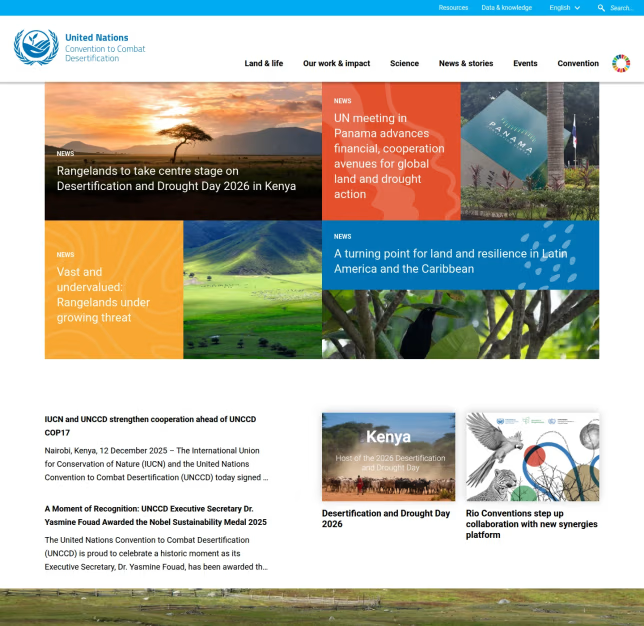
UNCCD operated four separate websites (two WordPress, two Drupal), leading to inconsistencies in design, content management, and user experience. A unified, scalable solution was needed to support a large-scale CMS migration project and improve efficiency and usability.
- Migrating all sites into a single, structured Drupal-based platform (government website Drupal DXP approach). - Implementing Storybook for a design system and consistency, reducing content development costs by 30–40%. - Managing input from 27 stakeholders while maintaining backend stability. - Integrating behavioral tracking, A/B testing, and optimizing performance for strong Google Lighthouse scores. - Converting Adobe InDesign assets into a fully functional web experience.
The modernization effort resulted in a cohesive, user-friendly, and scalable website, improving content management efficiency and long-term digital sustainability.
Oleksiy (PathToProject) worked with me on a specific project over a period of three months. He took full ownership of the project and successfully led it to completion with minimal initial information.
His technical skills are unquestionably top-tier, and working with him was a pleasure. I would gladly collaborate with Oleksiy again at any opportunity.

Nikolaj Stockholm Nielsen
Strategic Hands-On CTO | E-Commerce Growth
As Dev Team Lead on my project for 10 months, Oleksiy (PathToProject) demonstrated excellent technical skills and the ability to handle complex Drupal projects. His full-stack expertise is highly valuable.

Laurent Poinsignon
Domain Delivery Manager Web at TotalEnergies
Oleksiy (PathToProject) has been a valuable developer resource over the past six months for us at LSHTM. This included coming on board to revive and complete a stalled Drupal upgrade project, as well as carrying out work to improve our site accessibility and functionality.
I have found Oleksiy to be very knowledgeable and skilful and would happily work with him again in the future.