Platform Scope

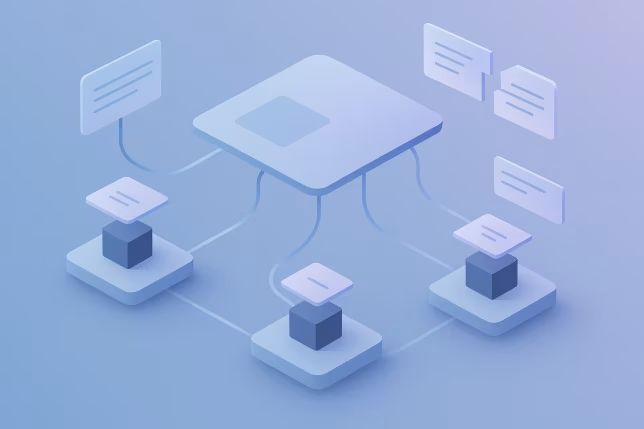
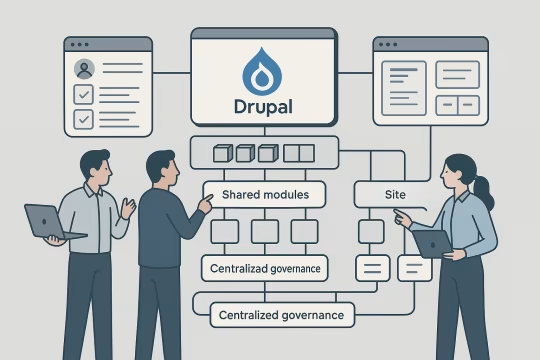
Global multi-brand ecosystems
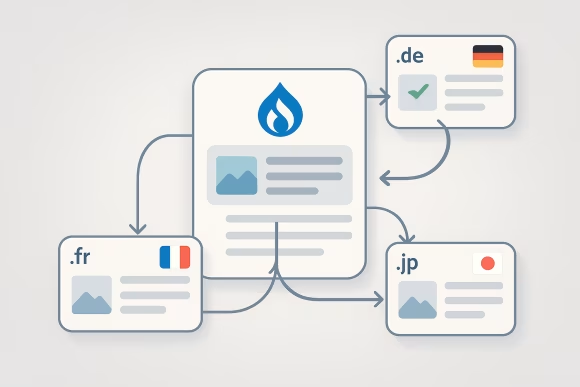
Multi-region deployments
Franchise & distributed organizations

Architecture Models

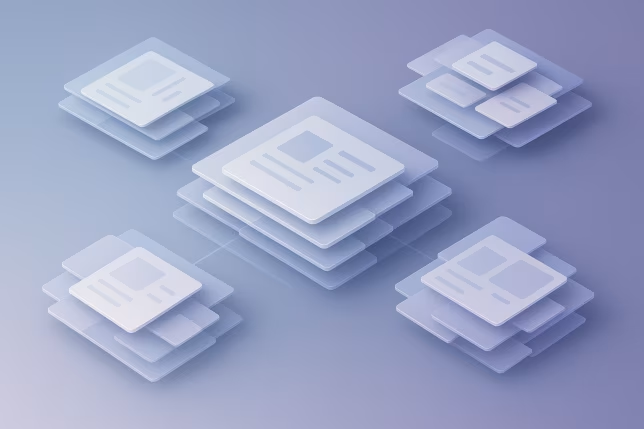
  • Drupal Multisite
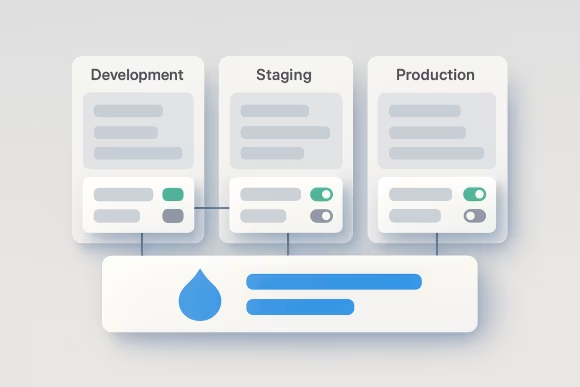
  • Shared Codebase with Split Config
  • Multi-domain / Multi-language setups

Governance Focus

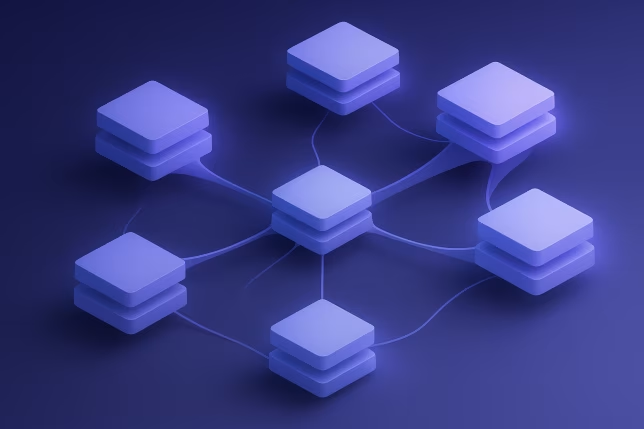
  • Centralized security
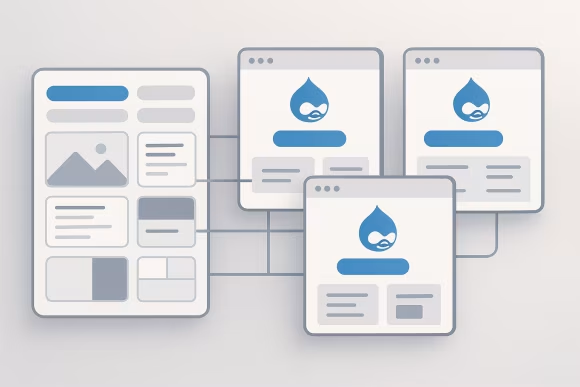
  • Shared components
  • Controlled editorial workflows

Scalability

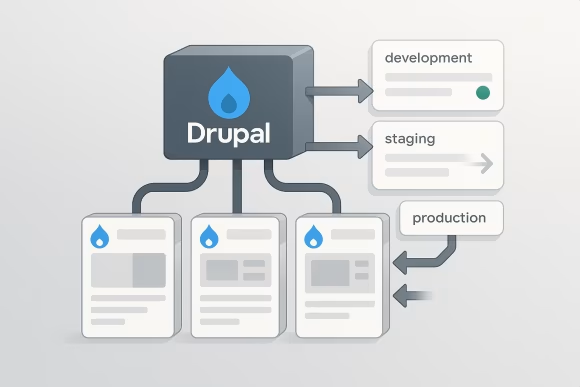
  • Horizontal scaling
  • Cloud-native deployments
  • CI/CD automation

Why Multisite Platforms Become Complex & Fragile

As organizations grow, they often launch new sites for regions, campaigns, brands, or departments. Without a clear Drupal platform strategy for a multi-brand and multi-domain setup, teams end up maintaining parallel builds that look similar but behave differently. Codebases drift, configuration diverges, and architectural decisions get repeated across properties—creating fragmentation that is expensive to reverse. Governance becomes inconsistent across domains, and the effort required to keep security patches, modules, and dependencies aligned increases with every additional site.

Over time, delivery slows as teams spend more time coordinating releases and resolving cross-site inconsistencies than building new capabilities. Content models and editorial workflows diverge, making shared components harder to reuse and increasing the risk of breaking changes during updates. Operational complexity grows across environments (dev/stage/prod), and the platform becomes more fragile under traffic spikes, campaign launches, or organizational change.

In large portfolios, the challenge is not only scale but control: maintaining brand consistency and compliance while still allowing regional autonomy. Without disciplined Drupal shared codebase multisite governance, organizations accumulate technical debt, increase operational risk, and struggle to evolve the platform predictably.

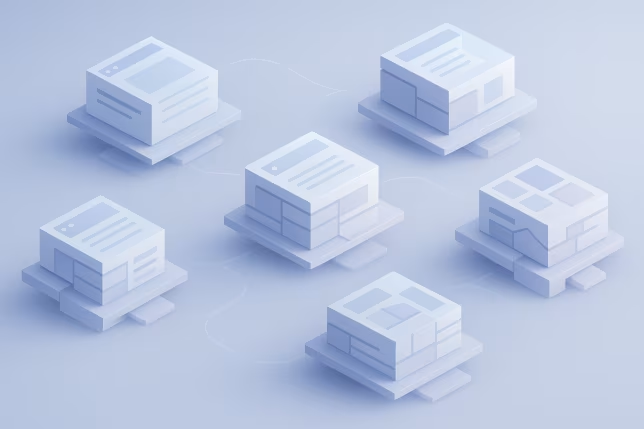
How to Build a Drupal Multisite Platform

Platform Discovery & Mapping

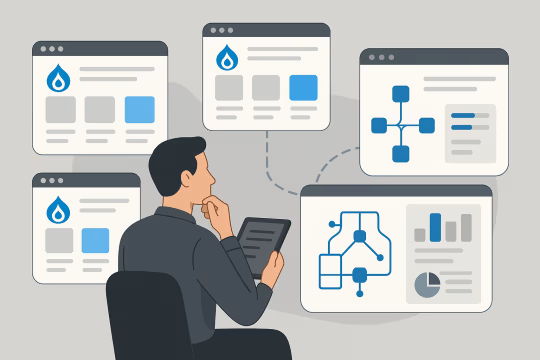
We analyze your existing site landscape, business structure, and governance model.

Architecture Blueprint

Design shared modules, components, config splits, and environment strategy.

Governance Framework

Define roles, workflows, publishing permissions, and security layers.

Reusable Component Library

Build standardized design system components usable across all sites.

CI/CD & DevOps Automation

Automated deployments for consistent updates across environments.

Scalability Planning

Ensure the platform supports future brands and acquisitions.

Core Multisite Capabilities

Our Drupal multisite services focus on building an enterprise-ready foundation for a Drupal multi-brand platform using a shared codebase and disciplined configuration boundaries. Capabilities include structured config split and environment management, centralized security governance, reusable components, and multi-language and multi-domain readiness. The result is a maintainable multisite architecture that scales across brands and regions without creating fragmented implementations.

What We Deliver
  • Enterprise Drupal multisite architecture
  • Platform standardization
  • Reusable component libraries
  • Centralized governance models
  • Cloud-native deployment pipelines
  • Long-term platform evolution strategy
Who This Is For
  • Global brands managing multiple websites
  • Organizations with regional subsidiaries
  • Franchise-based business models
  • Universities & public institutions
  • Enterprises consolidating legacy sites
Technology Ecosystem
  • Drupal 10 / 11 / 12
  • Config Split
  • Domain Access / Multisite setups
  • Next.js (Hybrid Frontend)
  • AWS / Acquia / Platform.sh
  • Docker / CI/CD pipelines

How We Deliver

Delivery follows a clear engineering sequence: discovery and landscape mapping, architecture blueprinting, governance definition, and implementation/refactoring into a shared codebase multisite. We then harden security, standardize configuration and environments, and establish CI/CD practices so the Drupal multi-domain setup can evolve predictably over time.

Delivery card for Architecture Audit[01]

Architecture Audit

Comprehensive assessment of your current multisite landscape, including codebase structure, hosting topology, governance model, and content architecture. We identify duplication, inconsistencies, security risks, and scalability bottlenecks across brands and regions.

Delivery card for Technical Blueprint[02]

Technical Blueprint

Creation of a documented, scalable multisite architecture aligned with business growth. Includes shared modules strategy, configuration management model, brand theming layers, deployment workflow, and governance framework.

Delivery card for Implementation & Refactoring[03]

Implementation & Refactoring

Consolidation or migration of distributed sites into a unified multisite platform. Refactoring of custom modules, configuration alignment, theme standardization, and elimination of legacy technical debt.

Delivery card for Security Hardening[04]

Security Hardening

Implementation of centralized update strategy, patch management workflows, role-based access governance, and environment isolation. Ensures consistent security posture across all site instances.

Delivery card for Documentation & Training[05]

Documentation & Training

Structured documentation of platform standards, deployment processes, editorial workflows, and governance policies. Includes training sessions to empower internal teams for long-term platform sustainability.

Delivery card for Ongoing Platform Support[06]

Ongoing Platform Support

Continuous monitoring, performance optimization, module updates, and architectural evolution to support new brands, markets, and digital initiatives as your multisite ecosystem grows.

Business Impact

A structured multisite strategy significantly reduces duplication across brands and regions, lowering maintenance and infrastructure costs over time. New markets, microsites, or acquisitions can be launched faster using an established architectural blueprint rather than rebuilding from scratch. Centralized governance strengthens compliance, security consistency, and brand alignment across global operations. Operational complexity is reduced through shared tooling, streamlined updates, and unified deployment workflows. For executive leadership, this results in scalable digital expansion with predictable cost control and reduced technical fragmentation.

Reduced Maintenance Costs

A shared codebase and centralized updates eliminate duplicated effort across sites, reducing long-term operational and infrastructure overhead.

Faster Launch of New Sites

New brands, regions, or campaign microsites can be deployed quickly using predefined architectural and design patterns.

Improved Brand Consistency

Centralized design systems and governance ensure cohesive digital identity across global markets while allowing controlled local adaptation.

Better Security & Compliance

Unified patch management and governance policies reduce vulnerability exposure and support enterprise audit requirements.

Scalable Growth

The architecture supports expansion, acquisitions, and regional growth without restructuring the platform foundation.

Operational Simplicity

Consolidated deployment workflows and configuration management reduce complexity, enabling IT and digital teams to operate more efficiently.

Frequently Asked Questions

Drupal multisite architecture enables centralized governance while supporting distributed brands, regions, and business units. However, successful implementation requires disciplined configuration management, security alignment, and operational clarity. These FAQs address common strategic, technical, and commercial questions raised by CTOs, IT Directors, and platform owners evaluating or restructuring enterprise Drupal multisite ecosystems.

When is Drupal multisite the right strategy for our organization?

Drupal multisite is appropriate when multiple websites share structural similarities, governance standards, and long-term maintenance requirements. This typically applies to global brands, franchise networks, universities, or organizations operating across regions. If individual sites require complete technical independence, separate codebases may be more suitable. However, when duplication, inconsistent updates, and fragmented security management become operational burdens, a shared multisite architecture provides stronger control and long-term cost efficiency.

How does a shared codebase reduce maintenance and operational costs?

A unified Drupal codebase allows security patches, module updates, and feature enhancements to be applied once and distributed across all site instances. This eliminates duplicated development effort and reduces inconsistencies. Centralized updates also simplify compliance audits and vulnerability management. Instead of maintaining multiple divergent environments, IT teams manage a single architectural foundation, improving predictability and reducing long-term technical debt.

How do you balance centralized governance with regional flexibility?

Governance and flexibility are balanced through structured configuration management and role-based access control. Shared modules and design systems enforce platform standards, while configuration splits enable market-specific variations. Regional teams can manage localized content, language, and branding within predefined boundaries. This approach ensures brand consistency and security alignment without preventing local adaptation where business needs require differentiation.

Is Drupal multisite secure enough for enterprise environments?

When properly architected, Drupal multisite can strengthen security posture rather than weaken it. Centralized patch management ensures consistent update cycles across all sites. Role segmentation, environment isolation, and structured deployment workflows prevent unauthorized configuration drift. Security governance must be embedded into architecture design, including access control policies, environment segmentation, and controlled release pipelines.

What risks should be considered when implementing a multisite architecture?

The primary risk is architectural coupling. If not designed carefully, excessive shared dependencies may reduce flexibility or complicate feature rollouts. Clear separation between shared core functionality and site-specific configurations mitigates this risk. A documented governance model and environment-aware configuration strategy are essential to prevent unintended cross-site impact.

Can existing independent Drupal sites be consolidated into a multisite platform?

Yes, consolidation is common when organizations seek to reduce duplication and centralize governance. The process typically begins with an architectural audit to evaluate compatibility of content models, custom modules, and integrations. Refactoring may be required to standardize configurations and eliminate conflicting dependencies. Migration planning must include staged validation to ensure business continuity and controlled transition.

How are deployments managed across multiple sites in a multisite setup?

Deployments are typically managed through centralized CI/CD pipelines that distribute validated code changes to all environments. Configuration management ensures that environment-specific settings remain protected. Automated testing, staged releases, and rollback procedures reduce risk. Structured deployment governance ensures that updates do not unintentionally disrupt individual site instances within the ecosystem.

Does Drupal multisite improve or impact performance?

Multisite architecture itself does not inherently degrade performance. Each site instance can be tuned independently through caching strategies, infrastructure scaling, and CDN configuration. When properly designed, multisite can improve operational efficiency while maintaining site-level performance optimization. Infrastructure planning must align with traffic patterns and growth projections to ensure predictable scalability.

How scalable is Drupal multisite for future growth or acquisitions?

Drupal multisite supports horizontal expansion when architectural boundaries are clearly defined. New brands, regions, or campaign sites can be provisioned using standardized blueprints without rebuilding infrastructure. Scalability depends on governance discipline, deployment automation, and infrastructure elasticity. When these foundations are in place, multisite enables controlled growth without multiplying operational complexity.

What is the first step in initiating a Drupal multisite strategy?

The process begins with a structured platform audit to map your existing digital landscape, governance model, content structures, and hosting topology. Based on this analysis, an architectural blueprint is developed outlining shared components, configuration boundaries, security governance, and deployment workflows. This blueprint ensures that multisite implementation strengthens long-term scalability rather than introducing unmanaged complexity.

Related Projects

What Our Clients Say

Ready to Build a Scalable Drupal Multisite Platform?

Let’s design a structured, secure, and future-proof multisite architecture tailored to your organization’s growth strategy.

Oleksiy (Oly) Kalinichenko

Oleksiy (Oly) Kalinichenko

CTO at PathToProject

Do you want to start a project?